Zvi Zeitlin: A Life in Music
Born in the village of Dubrovna—now part of Belarus—Zvi Zeitlin was raised in Palestine, where his earliest violin lessons came from his father, a physician and amateur musician.
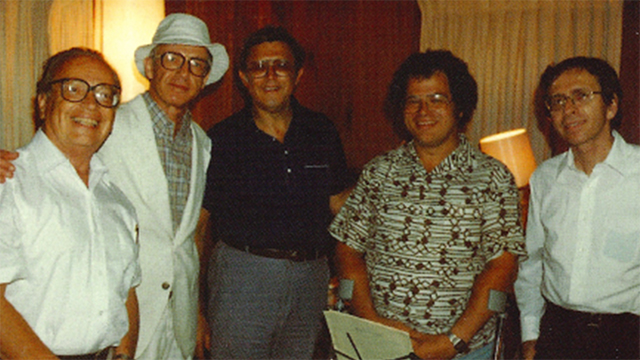
Born in the village of Dubrovna—now part of Belarus—Zvi Zeitlin was raised in Palestine, where his earliest violin lessons came from his father, a physician and amateur musician. At just 11 years old, Zvi became the youngest scholarship student in the history of The Juilliard School. He earned both a diploma and a postgraduate diploma from Juilliard. On the eve of World War II he returned to Palestine, where he launched his concert career and pursued Judaic Studies at the Hebrew University of Jerusalem. In 1943, he joined the Royal Air Force, performing for Allied troops across the Middle East.
Following the war, Zvi returned to Juilliard to study with the legendary violin pedagogue Ivan Galamian. His New York debut came in 1951 at The Town Hall, performing Bach, Schubert, and Stravinsky. From there, his international solo career flourished, bringing him to major stages around the world with leading orchestras under conductors such as Zubin Mehta, Christoph von Dohnányi, James Levine, Pierre Boulez, Lorin Maazel, Rafael Kubelík, Jascha Horenstein, and Antal Doráti. He toured extensively throughout Europe, Australia, New Zealand, Hong Kong, and Latin America.
Zvi became especially known for his close collaborations with modernist composers like Aaron Copland, Lukas Foss, and George Rochberg. He premiered numerous works written specifically for him, including pieces by Gunther Schuller, Paul Ben-Haim, and Carlos Surinach.
One of his signature interpretations was Arnold Schoenbergs notoriously complex, atonal Violin Concerto. His recording of the piece with the Bavarian Radio Orchestra conducted by Rafael Kubelík for Deutsche Grammophon remains a touchstone. His discography also includes all of Stravinskys violin and piano compositions, the unaccompanied Elegy , and works by Copland, Foss, Rochberg, and other American composers.
He made his debut with the New York Philharmonic in 1967, performing the Schoenberg concerto under Leonard Bernstein. Zvi was also a founding member of the Eastman Trio, performing alongside pianist Barry Snyder and cellist Robert Sylvester from 1976 to 1982.
Zvi concluded a remarkable 45-year teaching career at the Eastman School of Music in 2012. He was named Eastmans first Kilbourn Professor in 1974 and Distinguished Professor of Violin in 1998. In 2004, he received the Edward Peck Curtis Award for Excellence in Undergraduate Teaching from the University of Rochester. In January of his final year, he was honored as the inaugural recipient of the Emeritus Faculty Member title at the Music Academy, where he served as a teaching artist for 38 years, from 1973 to 2011.
His pedagogical impact extended worldwide through masterclasses and teaching engagements in Great Britain, Japan, Korea, China, Israel, Germany, Norway, Canada, and across the United States.
Zvi performed into his 80s on a 1734 Guarneri del Gesù violin. At Eastman, he gave his final major recital just two days before his 90th birthday, performing a program of Schubert.
"Zvi was a wonderful musician, a terrific fiddle player, and a very thinking kind of musician, said Itzhak Perlman. He was an extremely dedicated teacher, which is part of what makes somebody a complete musician.
Douglas Lowry, Joan and Martin Messinger Dean at Eastman, remarked: Zvi Zeitlin was one of those rare artists whose honesty and depth were direct reflections of his profoundly authentic humanity. His knowledge—not just of music but of life—was a marvel to behold, rooted in values, family, and artistic purpose. We mourn his passing, but celebrate the wisdom and poetry that he passes on.
During their time at the Music Academy, Zvi and his wife Marianne established the Zvi Zeitlin Endowed Scholarship, awarded annually to an outstanding violin fellow. For nearly 25 years, this scholarship has supported the Academys violin studio. We are grateful to Zvi not only for his passion for teaching but also for his unwavering belief in the power of classical music education and his commitment to the Academys full-scholarship model.